If you run a trade business, you've probably had the call. Someone promises to put you "at the top of the map" for a monthly fee. It's the most common pitch in local SEO for contractors, and Google's own help page answers it in one sentence: there's no way to request or pay for a better local ranking.
So what is local SEO for contractors, if it isn't something you buy? It's the work that helps people in your towns find your trade and then call you. That work happens in three places that need to agree with each other. Your website needs a page for each main service. Your Google Business Profile has to follow Google's rules for businesses that go to the customer. And you need a steady habit of asking for honest reviews.
This post sticks to what Google says publicly, plus plain advice for small trade businesses. No secret formula, because Google doesn't publish one.
Two kinds of results, two different jobs
When someone nearby searches "plumber near me" or "roof repair in [town]," Google usually shows two things. Each one leans on a different part of your setup.
- The map results (the short list of businesses with a map) come mostly from Google Business Profiles.
- The regular results under the map are websites.
Google's own help on how local ranking works says local results are mainly based on relevance (how well a profile matches the search), distance, and prominence (how well-known the business is, including information like reviews and links). It also says there's no way to request or pay for a better local ranking. That's the official picture. Anyone selling more certainty than that is guessing.
Your website and your profile have to tell the same story: same business name, same phone number, same service area, same services. A profile alone doesn't replace a useful website, and a website doesn't replace a complete, accurate profile.
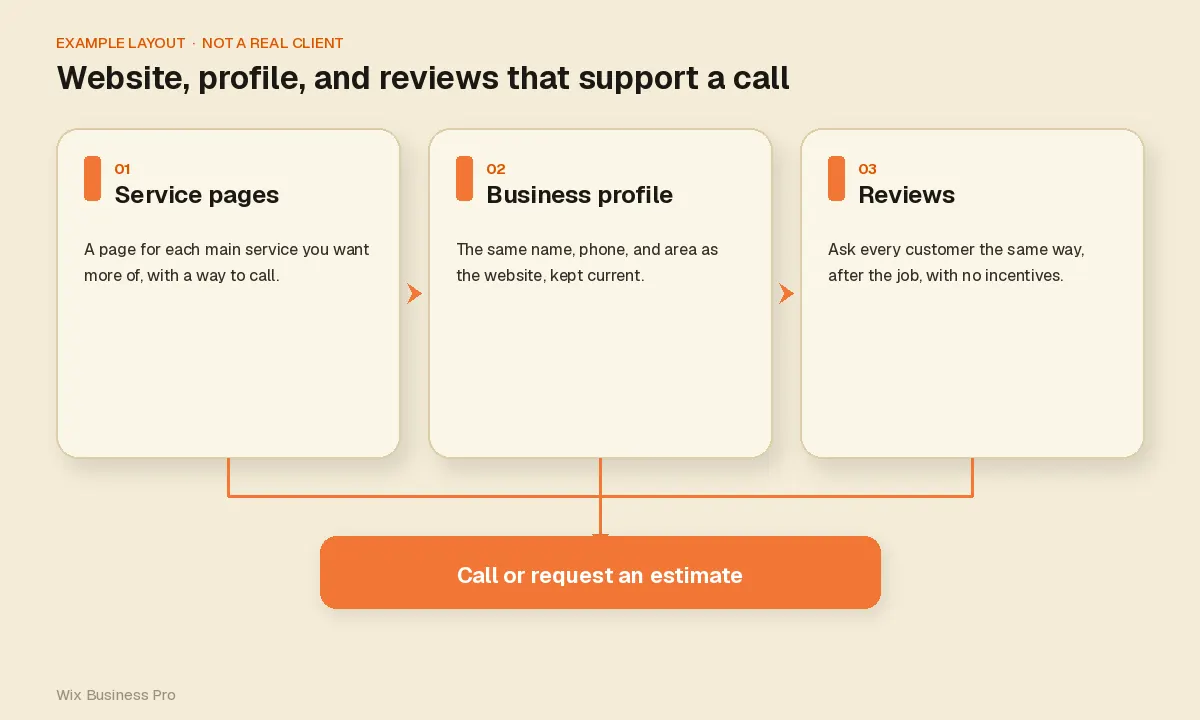
Example layout, not a real client. Service pages, a business profile, and reviews pointing to a call or estimate request.
Fix the website before chasing towns
Search can only send people to pages that exist. Before anything else, check that your site has:
- First screen. Your trade, your towns, tap-to-call, and an estimate button.
- One page per main service you want more of. Repair vs. replacement, emergency vs. planned work, each with real photos and a way to call.
- Service area in ordinary language. The towns and counties people actually say.
- Proof. License and insurance details as your state or province requires, plus genuine reviews.
The full page-by-page version is in our post on contractor website design. Google's SEO Starter Guide puts it simply: there are no secrets that will automatically rank a site first.
Town pages: when they help, and when they hurt
A town page earns its place when you have something real to say about that town. That might be jobs you've finished there, photos, reviews from customers in that town, or local details you actually know, like the housing types you work on.
A small set of useful town pages beats a long list of copies where only the town name changes. Google's spam policies describe that pattern as doorway abuse, including "pages targeted at specific regions or cities that funnel users to one page" and "substantially similar pages." Thin copy-swap pages can do more harm than good.
A good town page has:
- A real project from that town, with photos and a short description of the job.
- What you do there, and anything specific to working in that area.
- Reviews from customers in or near that town, if you have them.
- The same call and estimate buttons as the rest of your site.
Even a good town page won't guarantee rankings in that town. It gives people there a useful page to land on.
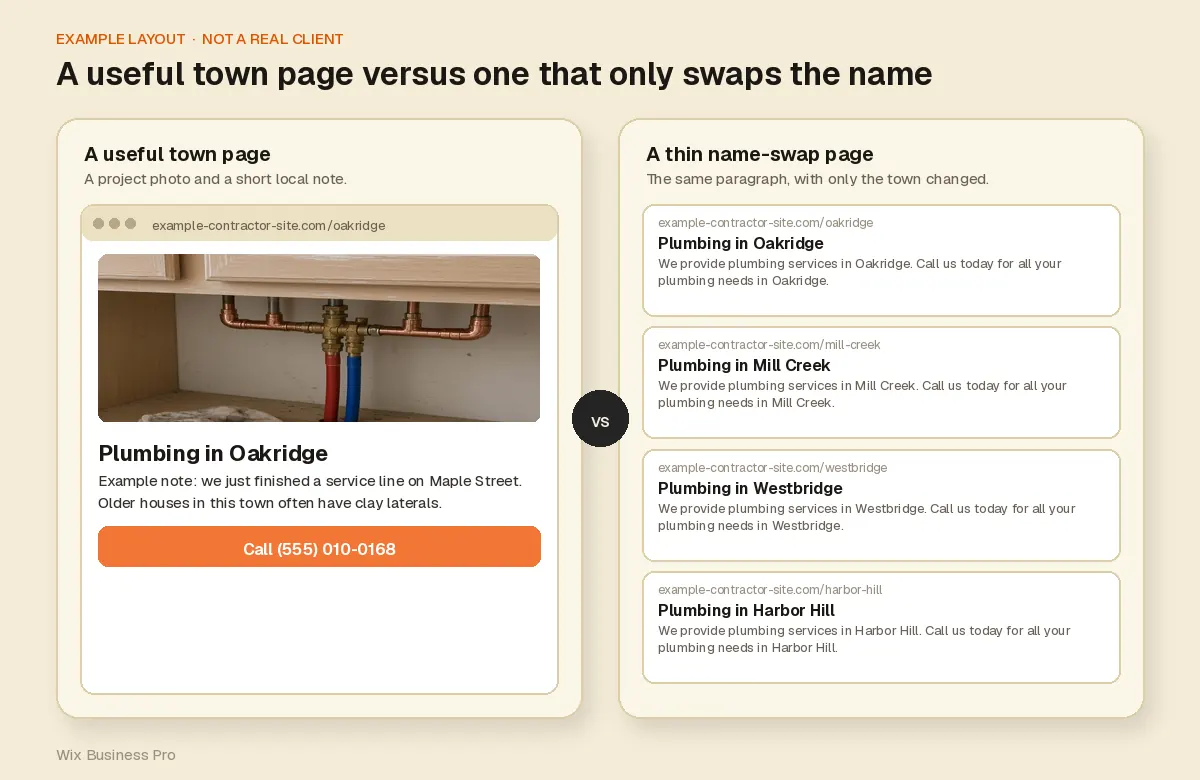
Example layout, not a real client or job. A useful town page versus pages that only swap the town name.
Setting up your Google Business Profile by the rules
Most of the profile is straightforward. Four settings matter most for trade businesses. For the general settings walkthrough, see our Google Business Profile settings guide.
- Business name: your real name only. Google's guidelines for representing your business say your name should match your real-world name, and that including unnecessary information can get your profile suspended. Don't add cities or services ("Smith Plumbing Austin Emergency Drain Cleaning").
- Categories: as few as it takes. The same guidelines say to use as few categories as possible to describe your core business, as specific as possible, and not to use categories as keywords. Pick the primary category for the work you most want. Add others only for work you really do.
- Address and service areas. Most contractors go to the customer. Google's help on service areas says that if you don't serve customers at your business address, you should remove it and set service areas instead. You can set up to 20, by city, postal code, or other area, but not as a radius around your shop. Google also notes the overall area shouldn't be more than "about 2 hours of driving time" from where you're based. List only places you actually serve.
- The rest, kept current. Hours, phone, website link, your services, and real job photos.
The profile and website should show the same name, phone, and area. This applies to contractors in Canada too: the profile rules are Google's, wherever you work.
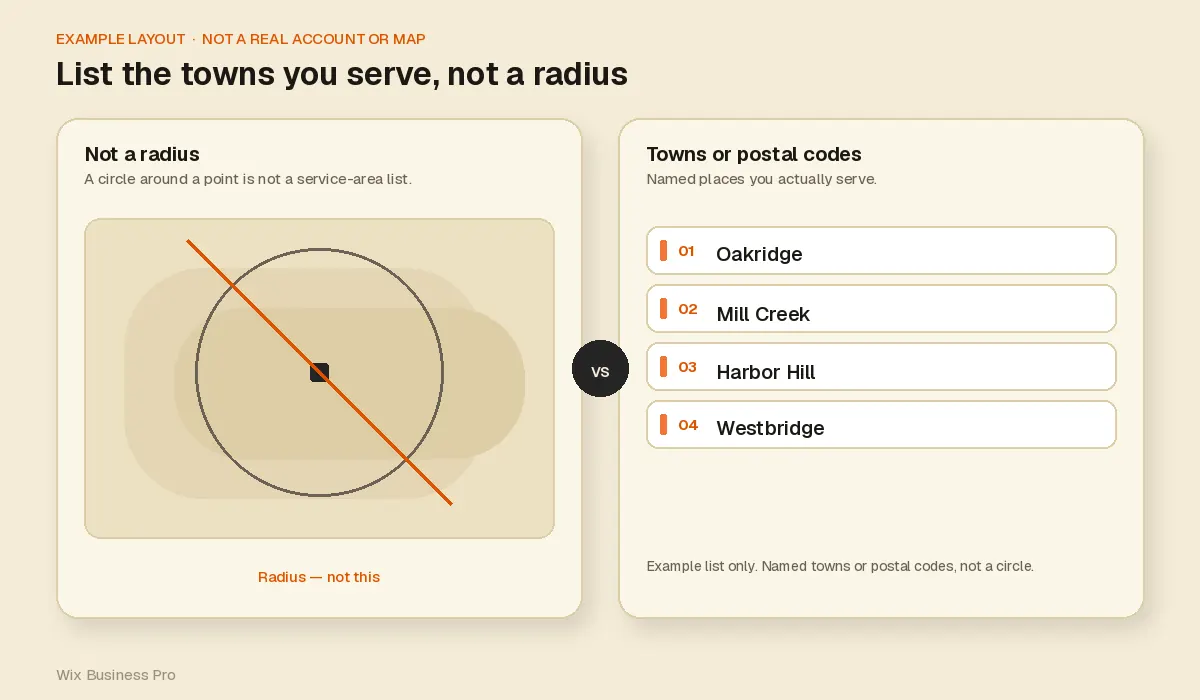
Example only, not a real account or map. Service areas as named towns, not a radius.
Asking for reviews without breaking the rules
The simplest system is also the one that stays inside Google's rules: ask every customer the same way, right after the job.
- Timing. Ask when the customer is looking at the finished work. A text with the link works well for trades.
- Ask everyone. Don't only ask the customers you think were happy.
- No incentives, ever. Google's tips to get more reviews say that offering free or discounted goods or services in exchange for reviews is "strictly prohibited." No discounts, gift cards, or raffles for reviews.
- Reply calmly. Google's tips also suggest keeping replies short, professional, and not promotional, and handling complex complaints privately.
More reviews won't move your ranking by any set amount. But honest reviews help homeowners choose, and Google lists them among the things that make a business better known. Breaking the rules can get content or a profile restricted, as Google's Business Profile policies explain.
Listings and Search Console, briefly
- Consistent listings. Your name, phone, and address (if you show one) should match on your website, your Google profile, and any other directories you actually use. You don't need hundreds of listings. You need the ones you have to be right.
- Google Search Console. It's free and shows whether Google has indexed your pages and which searches show your site. If people in your area use Bing, Bing Webmaster Tools does a similar job. Neither tool improves rankings on its own; they help you spot problems.
Pitches and shortcuts to turn down
- "Guaranteed #1" or "map pack in 30 days" promises.
- Towns or services stuffed into your Google business name.
- Dozens of thin town pages that only swap the name.
- Buying links. Google's spam policies call this link spam.
- Fake reviews or rewards for reviews.
- Treating the basic SEO setup of a new site as if it were an ongoing local SEO program. They're different things.
If you want a team to run this
Where we come in: If you need the website first, our Smart Website for contractors is $599 paid in full, or 2 payments of $349 ($698 total), per the live offer page on November 24, 2026. It's ready one week after we receive your completed onboarding form, with the first year of hosting included (then $250 per year for eligible custom-coded sites, only if you authorize it). Every build includes foundational SEO: clear page titles, wording that names your services and service areas, pages built for phones, and a structure search engines can read. The page calls this "a solid starting point, not a promise of rankings."
Ongoing SEO is optional, billed separately, and never part of the $599 price. Contractor Local ($95/month) focuses on your main city and nearby areas. Contractor Growth ($180/month) covers a wider service area, with ongoing local and regional SEO, conversion tracking setup, regular reporting, and, as setup work created at the start (not every month), one tailored service area page and one landing page for ad traffic. Ad campaign management and ad spend aren't included. These add-ons sit on top of the Smart Contractor Website, and final scope and cancellation terms are confirmed in writing. All amounts are in US dollars.
Already have a site you're keeping? Our standalone monthly SEO plans go by different names on our SEO and website pricing page: City Star is $95/month and State Leader is $180/month. Our managed SEO services page explains how that work runs, and as it says, "no one can honestly guarantee rankings."
A five-minute audit you can run on your phone
- Profile basics. Is your business name your real name only? Is your primary category the work you most want? Are your service areas towns or postal codes you actually serve, with your home address hidden if customers don't visit it?
- Match check. Do the name and phone on your website match your Google profile exactly?
- One service page. Add or improve the page for the job you want more of, with real photos.
- Phone test. Search for your business on your phone, open your site, and send yourself an estimate request. Did it arrive?
- Next review. Ask the customer on your next finished job, with a direct link.
For the bigger picture of how the website, profile, and fast replies fit together, read how contractors get more leads and grow.
Website first, SEO when you want it
Websites and SEO since 2013. Wix Partner since 2018. More about Wix Business Pro. Read the full terms on the offer page before you decide.
See the contractor website and SEO add-ons · Rather talk it through? Contact us.
Sources
Google and Wix help pages reviewed on November 23, 2026. Package names and prices were checked on our live offer and pricing pages on November 24, 2026; prices can change.
- Google Business Profile Help: Tips to improve your local ranking on Google.
- Google Business Profile Help: Guidelines for representing your business on Google.
- Google Business Profile Help: Manage your service areas.
- Google Business Profile Help: Tips to get more reviews.
- Google Business Profile Help: Overview of Google Business Profile policies.
- Google Search Central: Spam policies and SEO Starter Guide.
- Wix Business Pro: Smart Websites for Contractors and SEO services, and Pricing.
Questions trade owners ask about local SEO
What is local SEO for contractors?
It's the work that helps people near you find your trade in Google's map and website results: service pages on your site, an accurate Google Business Profile, and genuine reviews. It supports calls but can't buy a ranking.
My Google profile already brings in calls. Why bother with the website?
The profile mainly feeds the map results. The website shows up in the regular results below the map, and it's where people read about a service, see your work, and send an estimate request.
Should a contractor show their address on Google?
Only if customers visit you there during staffed hours. If you go to the customer, Google says to remove the address and set service areas instead.
Should I make a page for every town I serve?
No. Make one page per main service, and add a town page only where you have real jobs, photos, or reviews from that town.
Can I offer a discount for a Google review?
No. Google prohibits offering free or discounted goods or services in exchange for reviews. Ask every customer the same way, with no reward.
Will a Wix site hold me back in local search?
No. Wix's SEO best practices guide covers title tags, meta descriptions, headers, and URLs. Results depend far more on your content, profile, and reviews than on the platform.
What do your SEO plans for contractors cost?
With our Smart Contractor Website, ongoing SEO is optional: Contractor Local is $95/month and Contractor Growth is $180/month. If you're keeping your current site, our standalone plans start with City Star at $95/month and State Leader at $180/month (live pages, November 24, 2026). We don't guarantee rankings; we do the work and report on it.
How long does local SEO take?
There's no fixed timeline. Profile fixes can show sooner than new pages, and results depend on your market and competition.